Mon 23 Mar 2026
Angle facts
How to use this lesson
Work in your exercise book. When you see practice questions, copy the question number and diagram sketch (or short description) into your book, then answer. After each block, open the Mark accordion in that section. Some sections include in-page answers, and some later sections give marking guidance or paired question-and-answer pages. If you get stuck, go back to the applet or worked example — don’t skip straight to answers.
Key vocabulary
Key vocabulary
- Acute angle
- An angle smaller than 90°.
- Right angle
- Exactly 90° — often shown with a small square in a diagram.
- Obtuse angle
- An angle between 90° and 180°.
- Reflex angle
- An angle bigger than 180° (the “big” way round).
- Parallel lines
- Lines that never meet; they stay the same distance apart.
- Perpendicular lines
- Lines that meet at 90°.
- Vertex
- The corner point where two lines meet.
- Transversal
- A line that crosses two or more other lines.
1. Angles in a right angle add to 90°
If two (or more) angles sit inside a right angle and fill it completely, their sizes add to 90°.
This comes up all the time when a square corner is split into two smaller angles a and b:
a + b = 90°
Interactive: angles in a right angle
Live angle sizes
- First angle (by horizontal arm)
- 32.0°
- Second angle (by vertical arm)
- 58.0°
- Sum check
- 90.0°
Drag the orange handle. Numbers update live.
Worked example
Problem: Two angles sit in a right angle. One is 27°. Find the other.
Working: They add to 90°, so missing angle = 90 − 27 = 63°.
Check: 27 + 63 = 90 ✓
Practice — Angles in a right angle
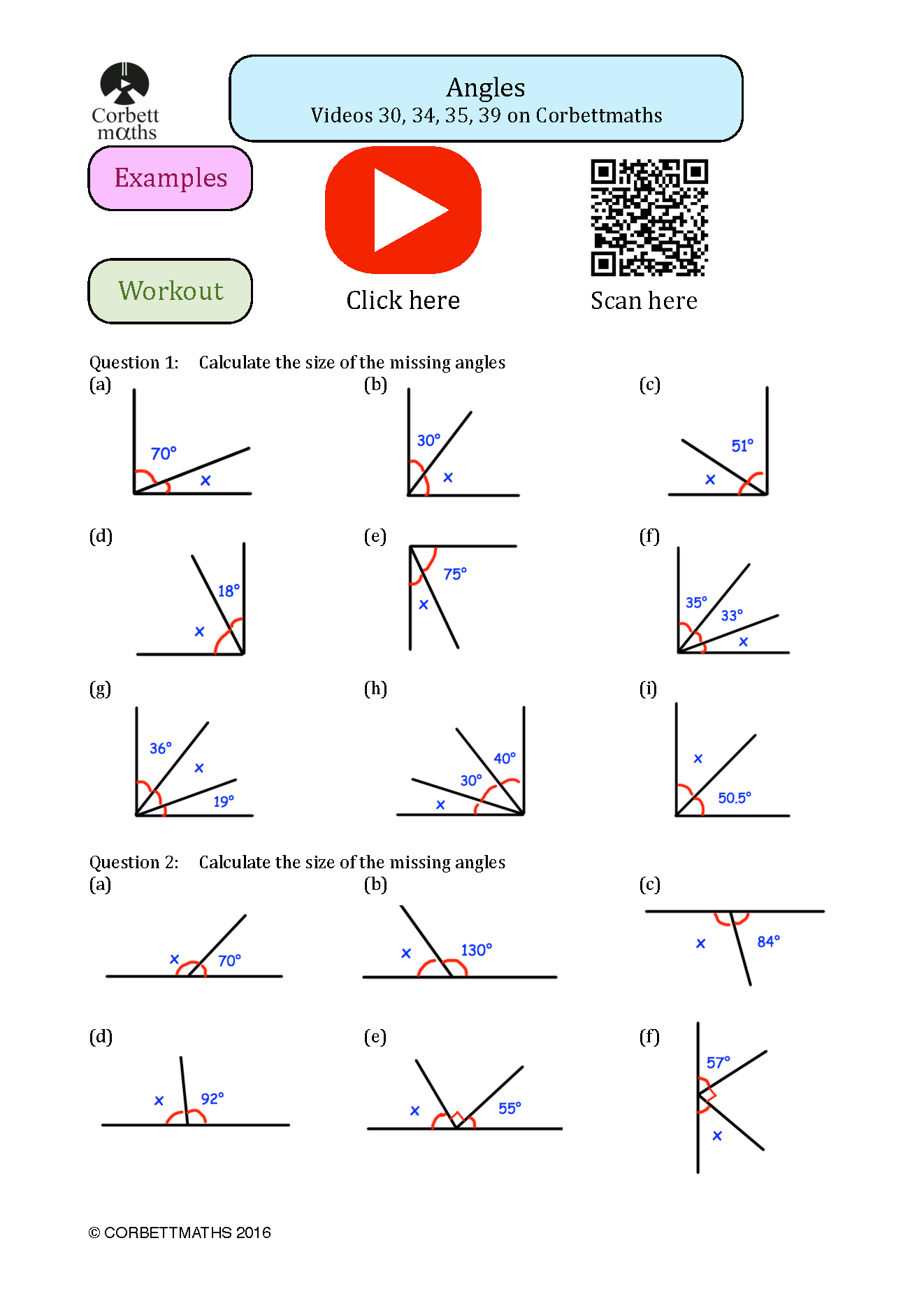
From the Corbett worksheet: do Question 1 only — copy each part into your book. This page also shows the start of Question 2 lower down, so ignore that for now.
Mark — Question 1
Corbett worksheet — Question 1 (angles in a right angle)
(a) 20° · (b) 60° · (c) 39° · (d) 72° · (e) 15°
(f) 22° · (g) 35° · (h) 20° · (i) 39.5°
✓ Checkpoint: After this section you should be able to use a + b = 90° when angles sit
inside a right-angle corner.
2. Angles on a straight line add to 180°
Angles that sit on a straight line (around a single point on the line) add to 180°.
Interactive: angles on a straight line
Live angle sizes
- One side of the vertex
- 58.0°
- Other side
- 122.0°
- Sum check
- 180.0°
Drag the orange handle. Numbers update live.
Worked example
Problem: Two angles on a straight line are 41° and x°. Find x.
Working: They add to 180°, so x = 180 − 41 = 139°.
Practice — Straight line
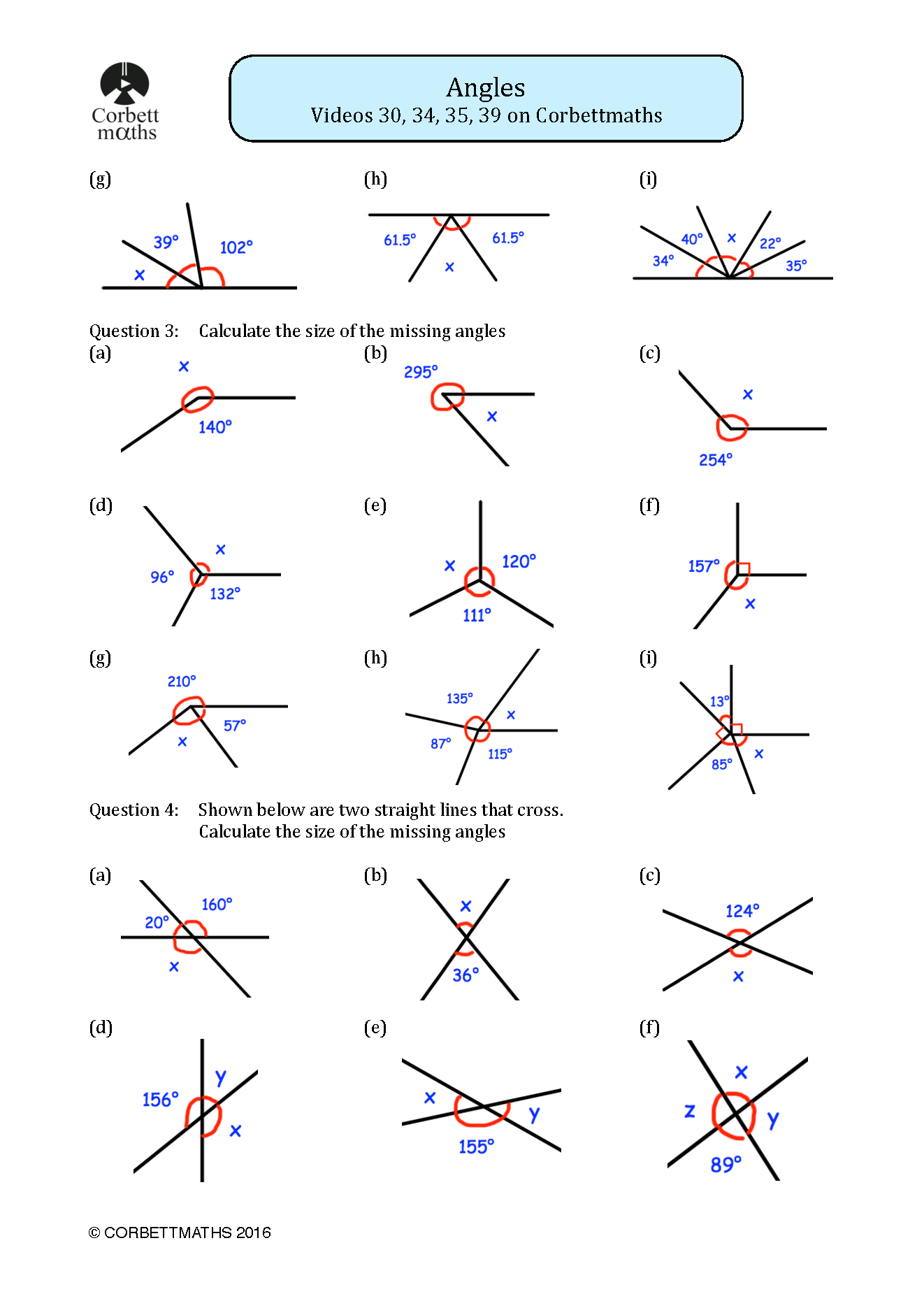
Corbett worksheet: do Question 2 only (starts on page 1 and continues on page 2). Ignore Question 1 above it on page 1, and stop once Question 2 finishes on page 2.
Mark — Question 2
Question 2 (straight line, 180°)
(a) 110° · (b) 50° · (c) 96° · (d) 88° · (e) 125° · (f) 123°
(g) 39° · (h) 57° · (i) 49°
✓ Checkpoint: You should be able to set up sum = 180° for angles on a straight line.
3. Angles around a point add to 360°
A full turn is 360°. If angles meet at a point and go all the way round, they add to 360°.
Interactive: angles around a point
Live angle sizes
- Sector 1 (drag handle)
- 110.0°
- Sector 2
- 130.0°
- Sector 3
- 120.0°
- Sum check
- 360.0°
Drag the orange handle. Numbers update live.
Worked example
Problem: Three angles around a point are 110°, 95° and x°. Find x.
Working: x = 360 − 110 − 95 = 155°.
Practice — Around a point
Corbett worksheet: do Question 3 only on page 2. Ignore any later question blocks further down that page.
Mark — Question 3
Question 3 (around a point, 360°)
(a) 220° · (b) 65° · (c) 106° · (d) 132° · (e) 129°
(f) 113° · (g) 93° · (h) 23° · (i) 172°
✓ Checkpoint: You can explain in one sentence why the total around a point is 360°.
4. Vertically opposite angles are equal
When two straight lines cross, the opposite pair of angles are equal.
Interactive: vertically opposite angles
Live angle sizes
- Each vertically opposite angle
- 48.0°
- Adjacent on a straight line
- 132.0°
Drag the orange handle. Numbers update live.
Worked example
Problem: Two lines cross. One angle is 128°. Find x, the vertically opposite angle.
Working: Vertically opposite angles are equal, so x = 128°.
Also find a neighbour on a straight line: the angle next to 128° on a straight line is 180 − 128 = 52°.
Practice — Vertically opposite
Corbett worksheet: do Question 4 only on page 2. Ignore the earlier question block above it.
Mark — Question 4
Question 4 (vertically opposite)
(a) x = 20°
(b) x = 36°
(c) x = 56°
(d) x = 156°, y = 24°
(e) x = 155°, y = 25°
(f) x = 89°, y = 91°, z = 89°
✓ Checkpoint: You can spot the X structure in crossing lines and use equal opposite
angles.
5. Angles in a triangle add to 180°
The three interior angles of any triangle add to 180°.
Interactive: angles in a triangle
Live angle sizes
- Angle at A
- 73.7°
- Angle at B (drag)
- 53.1°
- Angle at C
- 53.1°
- Sum check
- 180.0°
Drag the orange handle. Numbers update live.
Worked example
Problem: A triangle has angles 54° and 61°. Find the third angle.
Working: Third angle = 180 − 54 − 61 = 65°.
Practice — Triangles (general)
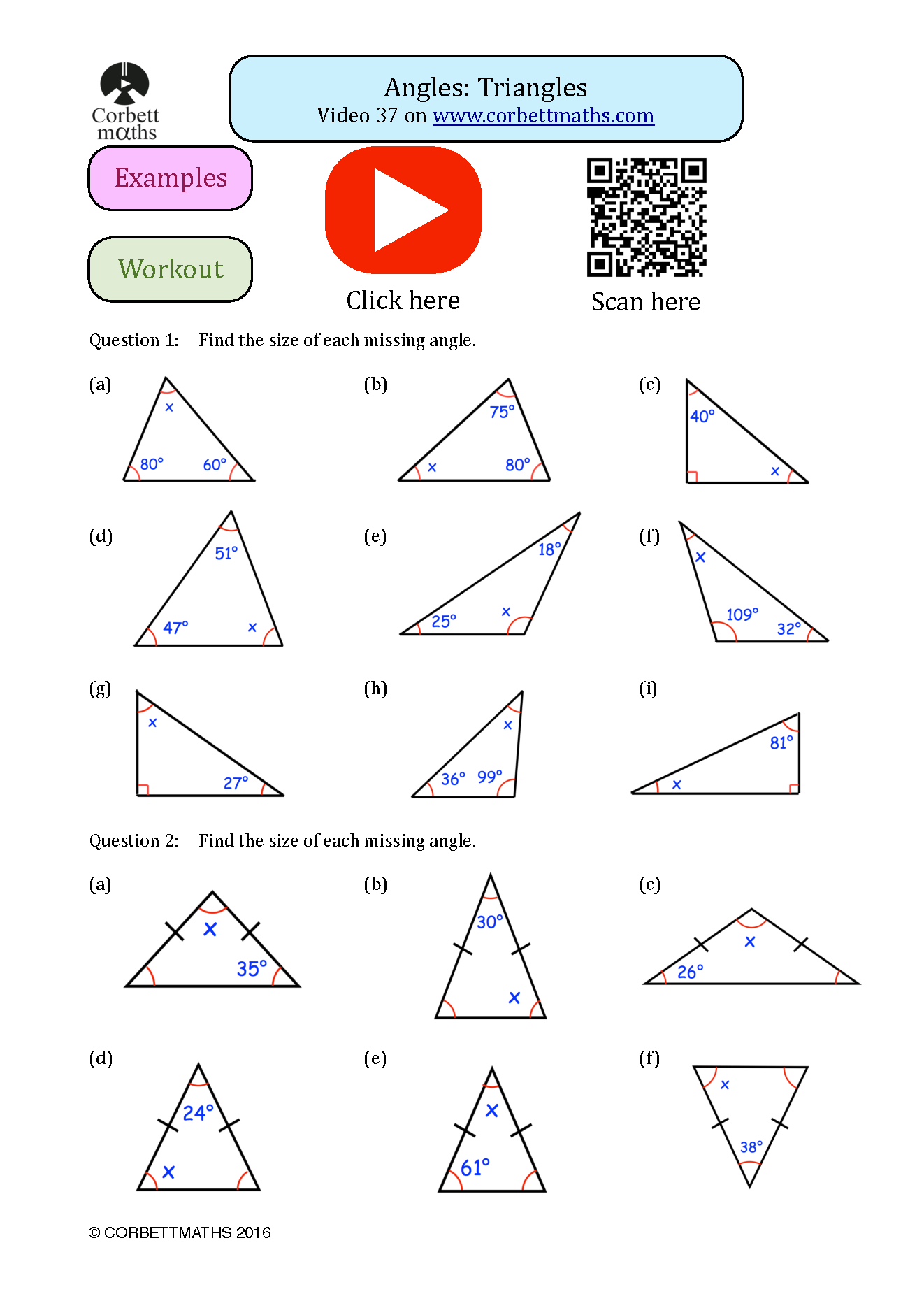
On the Corbett triangle sheet below, do Question 1 only for now. Questions 2 and 3 are covered after you learn isosceles and equilateral facts.
Mark — Question 1 (triangles)
✓ Checkpoint: You can use a + b + c = 180° for interior angles in a triangle.
6. Isosceles triangles: base angles are equal
An isosceles triangle has two equal sides. The angles underneath those equal sides (the base angles) are equal.
Interactive: isosceles triangle (base angles equal)
Live angle sizes
- Base angle (left)
- 62.4°
- Base angle (right)
- 62.4°
- Apex
- 58.8°
Drag the orange apex up or down. The triangle stays isosceles as the angles change.
Worked example
Problem: An isosceles triangle has one base angle of 70°. Find x, the top angle.
Working: The base angles are equal, so the other base angle is also 70°.
So x = 180 − 70 − 70 = 40°.
Worked example
Problem: In another isosceles triangle, the top angle is 40°. Find x, a base angle.
Working: The two base angles are equal, so they share 180 − 40 = 140°.
That gives x = 140 ÷ 2 = 70°.
Practice — Isosceles
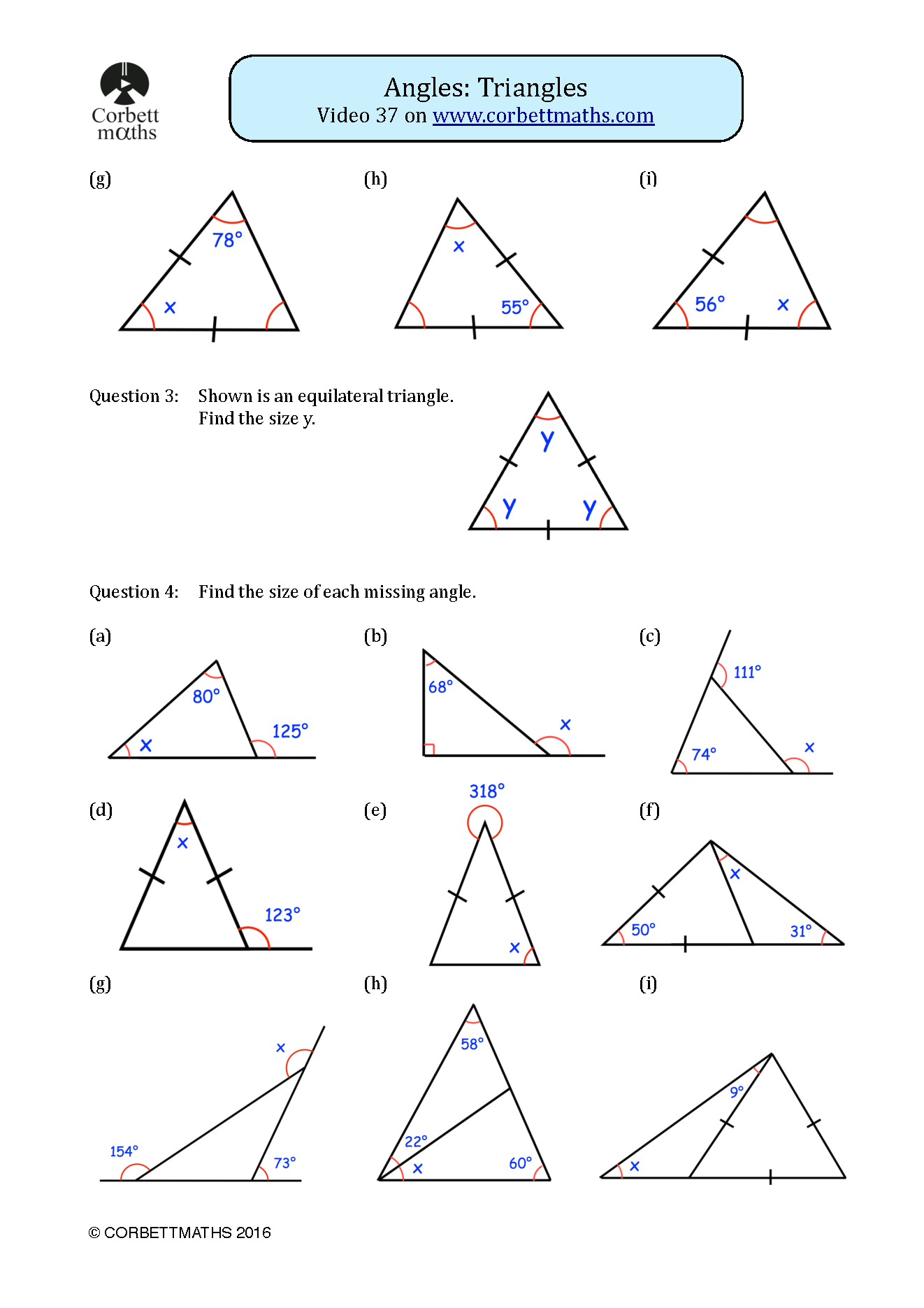
Same Corbett triangle sheet: do Question 2 only (look for the tick marks showing two equal sides). Question 2 starts on page 1 and finishes with parts (g) to (i) at the top of page 2.
Mark — Question 2 (isosceles)
✓ Checkpoint: You can explain which angles are the base angles when two sides are equal.
7. Equilateral triangles: every angle is 60°
If all three sides are equal (equilateral), then all three angles are 60°.
Interactive: equilateral triangle
Live angle sizes
- Each angle
- 60°
- Side length
- 217.1 units
- Sum
- 180°
Drag the top vertex up or down. The triangle resizes, but every angle stays 60°.
Worked example
Problem: An equilateral triangle has one angle labelled x. Find x.
Answer: x = 60°, because every angle in an equilateral triangle is 60°.
Practice — Equilateral
Same Corbett triangle sheet: do Question 3 only. It is the equilateral triangle in the middle of page 2. Ignore the last three isosceles parts above it and the Question 4 block below it.
Mark — Question 3 (equilateral)
✓ Checkpoint: You remember: equilateral → 60° each.
8. Mixed triangle practice
Now that you know general triangles, isosceles, and equilateral, you can tackle the mixed triangle questions.
Practice — Mixed triangles
Use the second triangle worksheet page below for mixed triangle practice, but do Question 4 only. Ignore the isosceles parts at the top and the equilateral Question 3 in the middle.
Mark — mixed triangles
9. Angles in a quadrilateral add to 360°
The four interior angles of any quadrilateral add to 360°.
Interactive: angles in a quadrilateral
Live angle sizes
- Bottom-left
- 77.4°
- Bottom-right
- 83.7°
- Top-right
- 95.4°
- Top-left
- 103.5°
- Sum check
- 360.0°
Drag any orange vertex. The shape stays convex and the angle sum updates live.
Worked example
Problem: Three angles in a quadrilateral are 90°, 110° and 70°. Find the fourth.
Working: Fourth angle = 360 − 90 − 110 − 70 = 90°.
Practice — Quadrilaterals
On the sheet below, do Question 1 only. Question 2 often needs angles in parallel lines, which you study in the next sections — skip it for now.
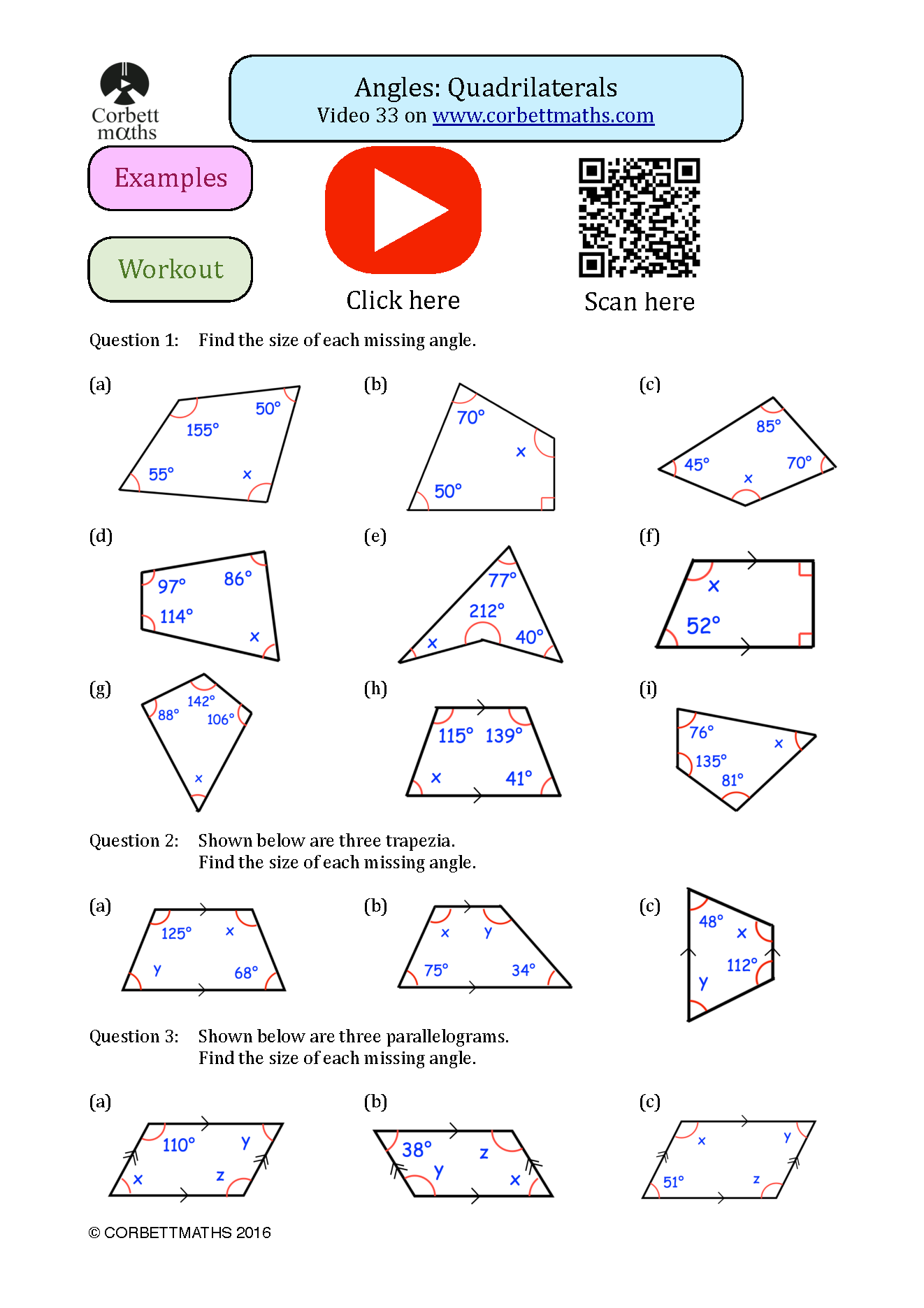
Mark — Question 1 (quadrilateral)
✓ Checkpoint: You can use sum = 360° for the four interior angles in a quadrilateral.
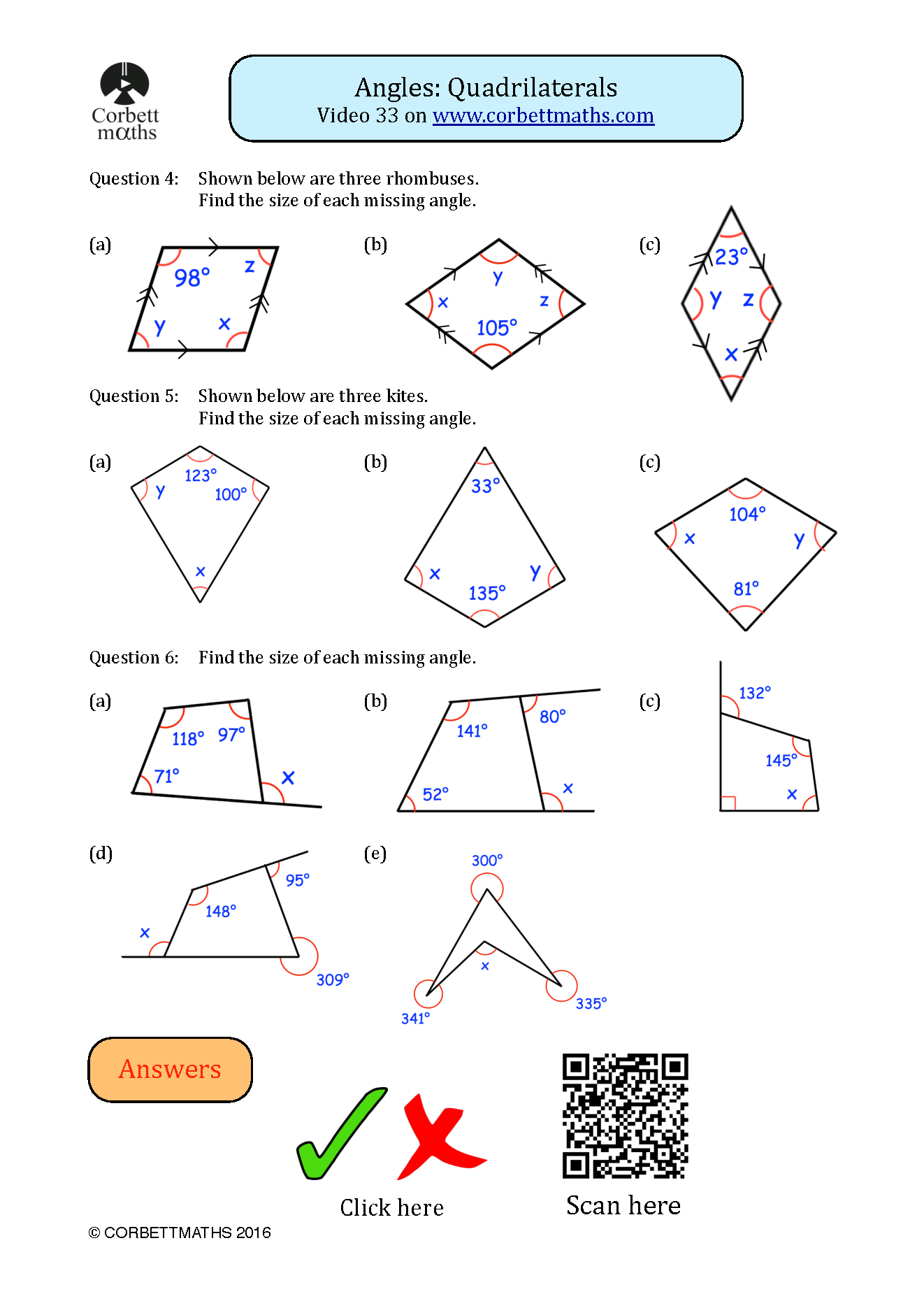
Optional — extra quadrilateral diagrams
If your teacher sets more quadrilateral work, use these extra diagrams as well (some questions may need ideas from later topics):
10. Parallel lines — corresponding angles
When a transversal crosses parallel lines, corresponding angles are in the same relative position at each parallel — they are equal (often drawn as an F shape).
Interactive: corresponding angles
Live angle sizes
- Matching pair (each)
- 48.0°
Drag the orange handle. Numbers update live.
Worked example
Problem: Parallel lines with a transversal. One corresponding angle is 52°. Find x.
Working: Corresponding angles are equal, so x = 52°.
11. Parallel lines — alternate angles
Alternate angles are equal and sit in a Z shape between the parallels.
Interactive: alternate angles
Live angle sizes
- Matching pair (each)
- 48.0°
Drag the orange handle. Numbers update live.
Worked example
Problem: Parallel lines with a transversal. One alternate angle is 58°. Find x.
Working: Alternate angles are equal, so x = 58°.
12. Parallel lines — co-interior angles
Co-interior angles are between the parallels on the same side of the transversal. They add to 180° (a C or U shape).
Interactive: co-interior angles
Live angle sizes
- Co-interior angle (upper)
- 48.0°
- Co-interior angle (lower)
- 132.0°
- Sum check
- 180.0°
Drag the orange handle. Numbers update live.
Worked example
Problem: One co-interior angle is 72°. Find x.
Working: Co-interior angles add to 180°, so x = 180 − 72 = 108°.
These three facts are easy to mix up. Use the paired booklet pages below and say the rule out loud each time: corresponding, alternate, or co-interior.
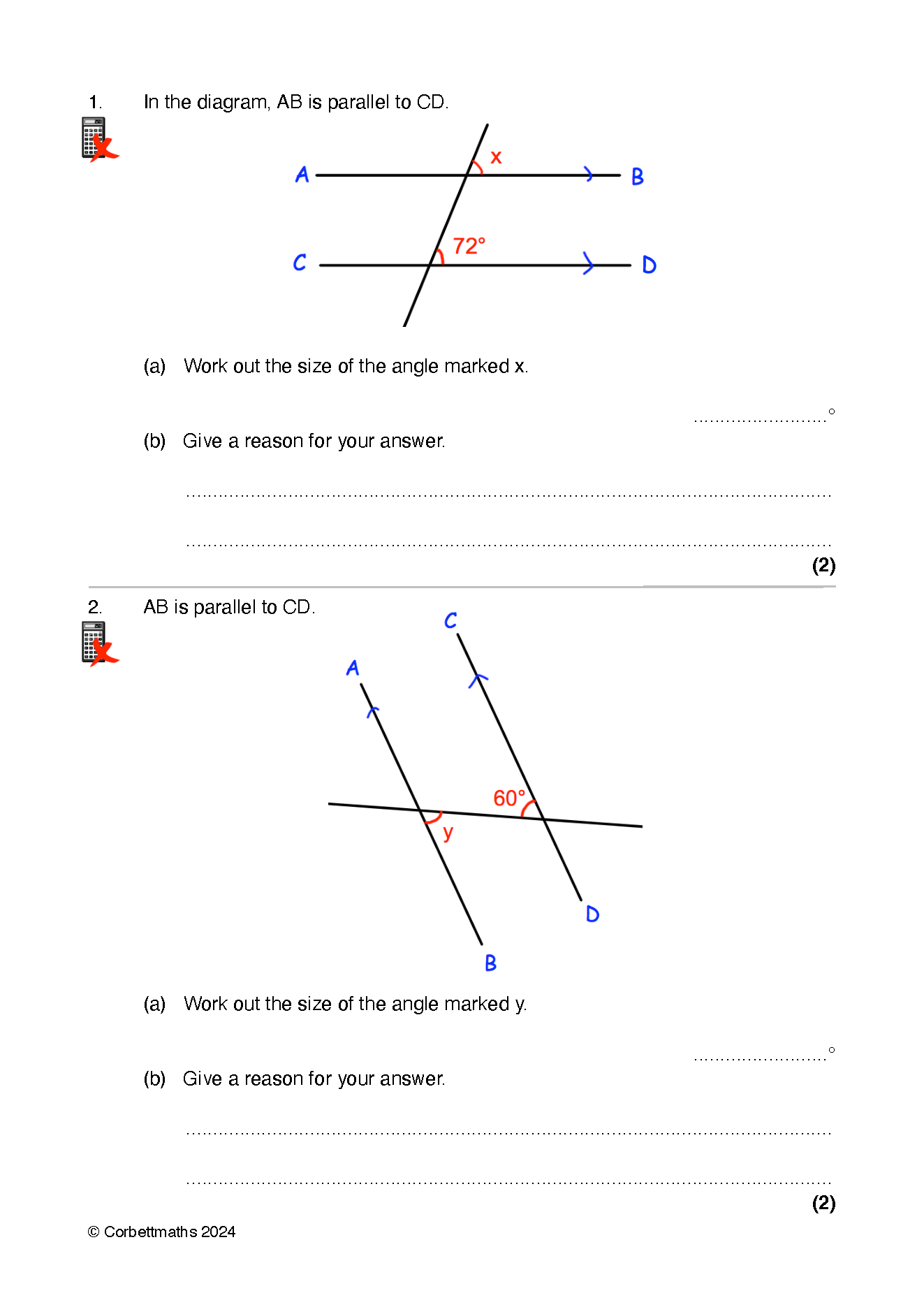
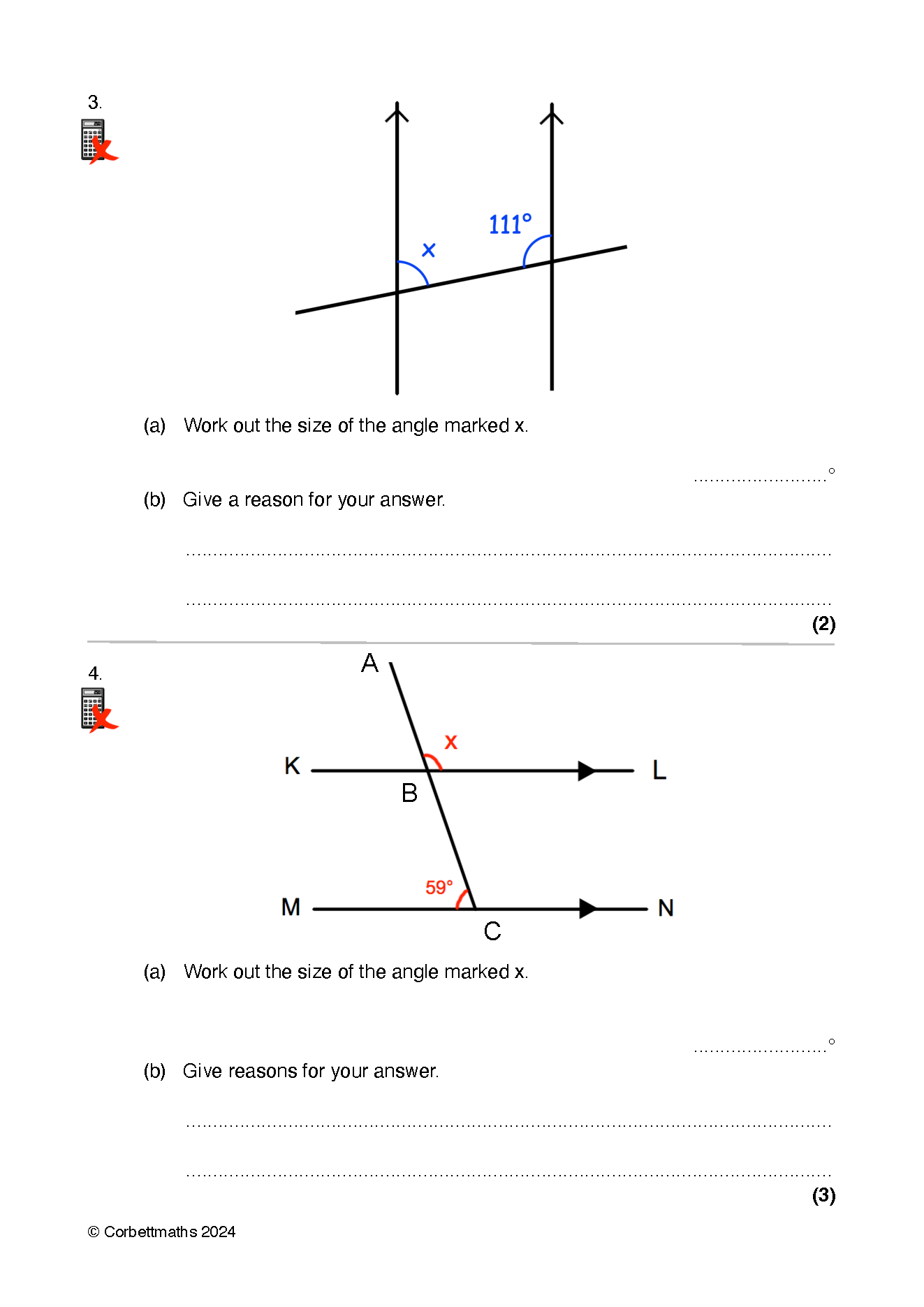
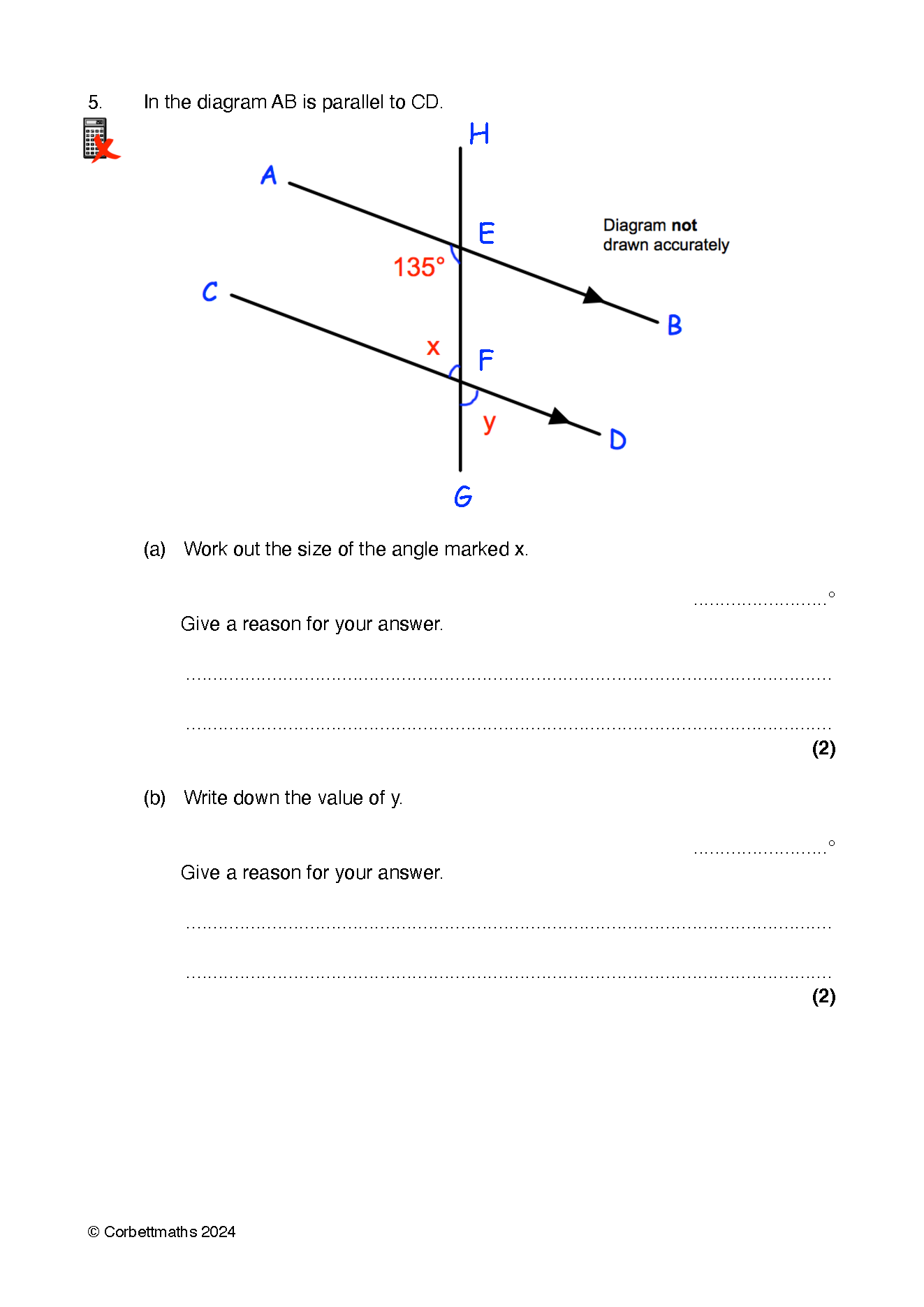
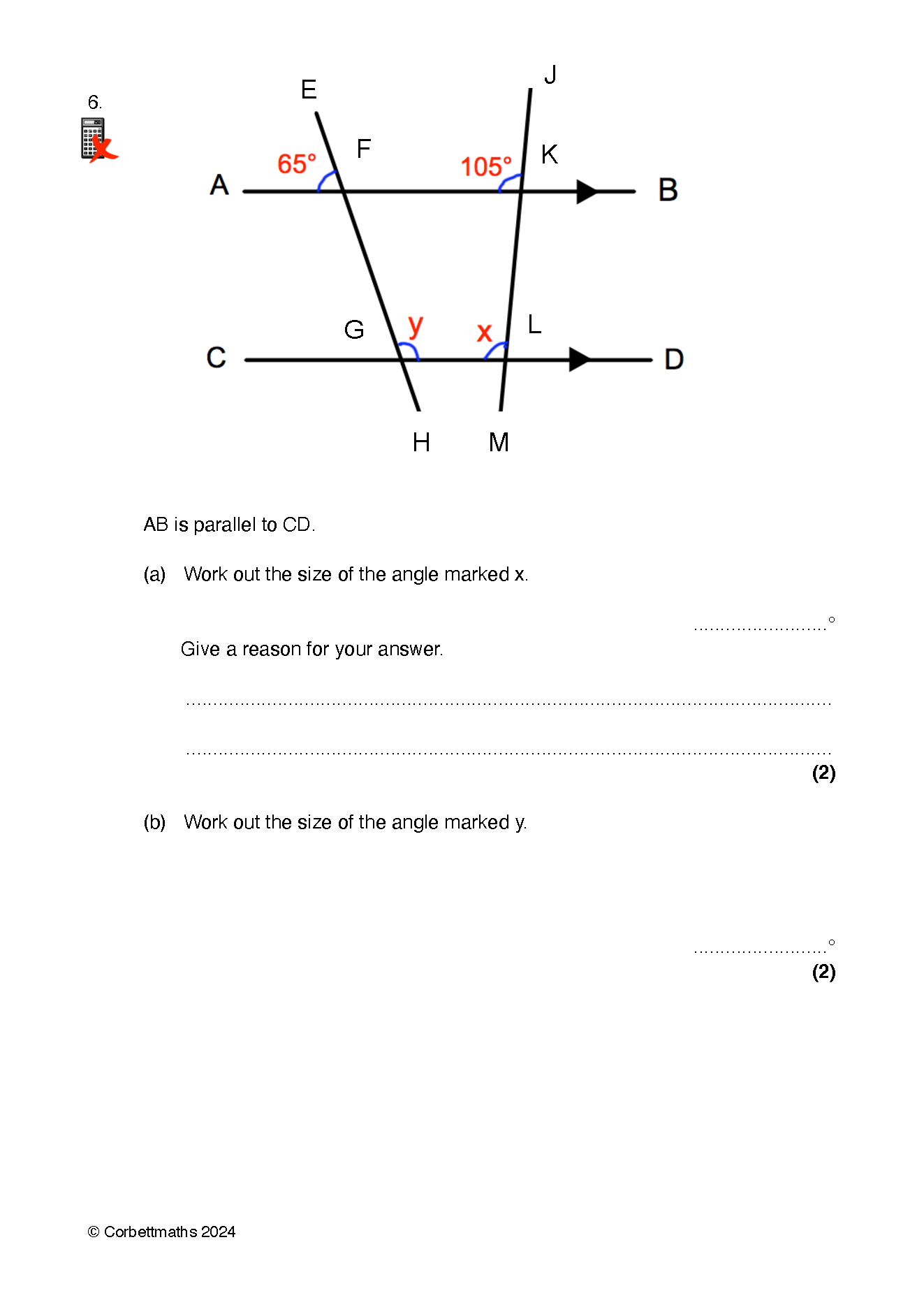
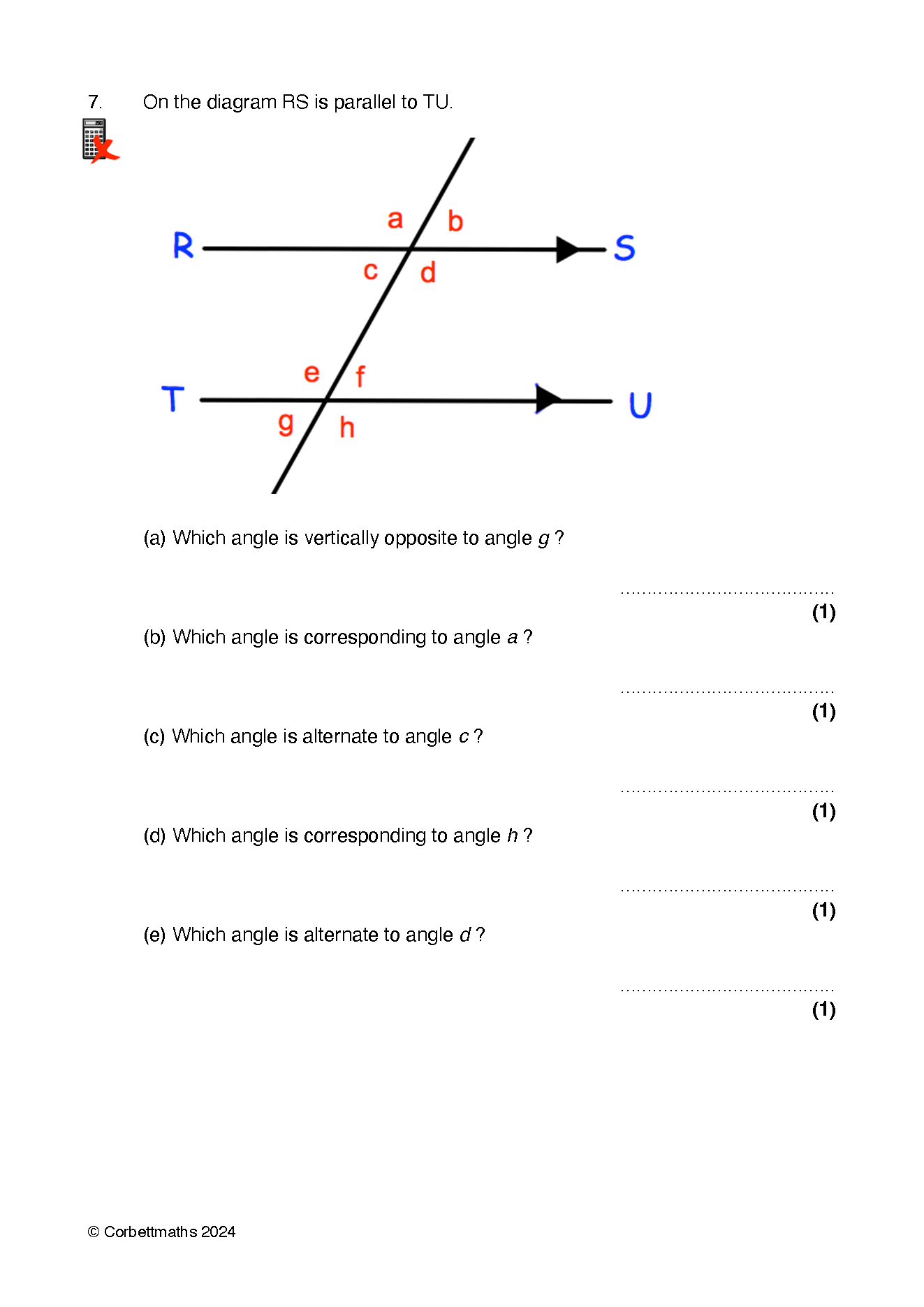
✓ Checkpoint: You can spot F / Z / C patterns and name corresponding, alternate, co-interior.
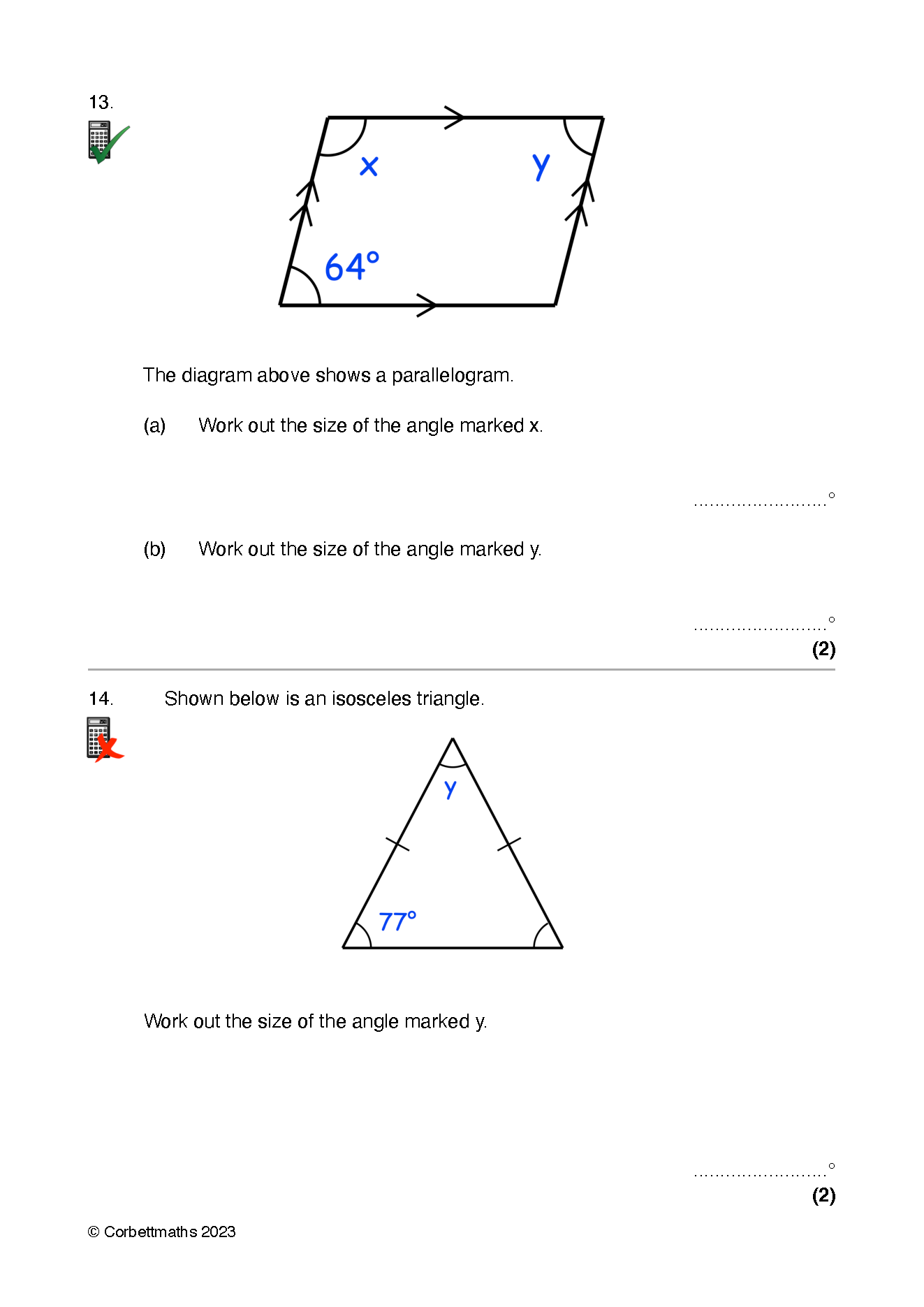
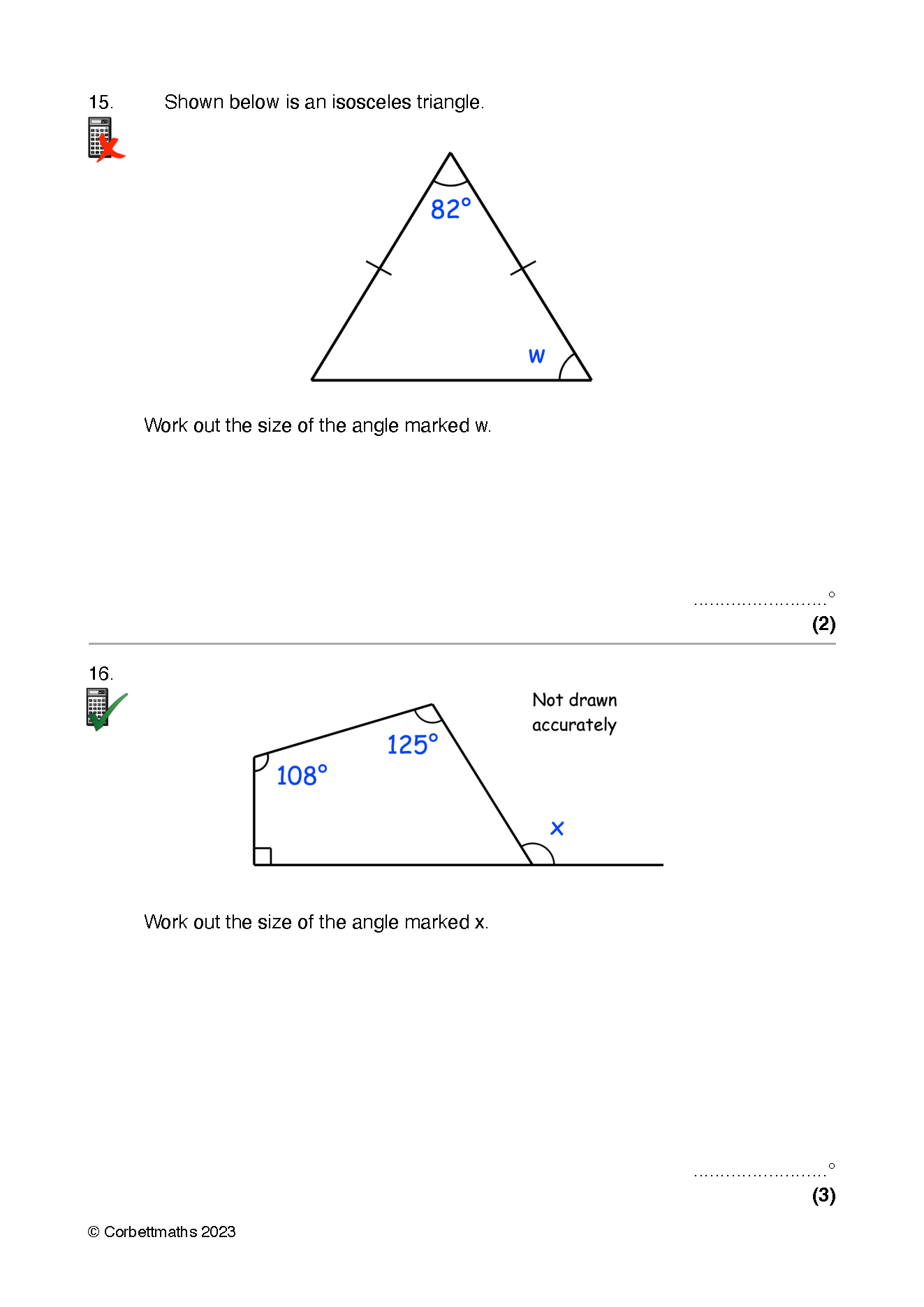
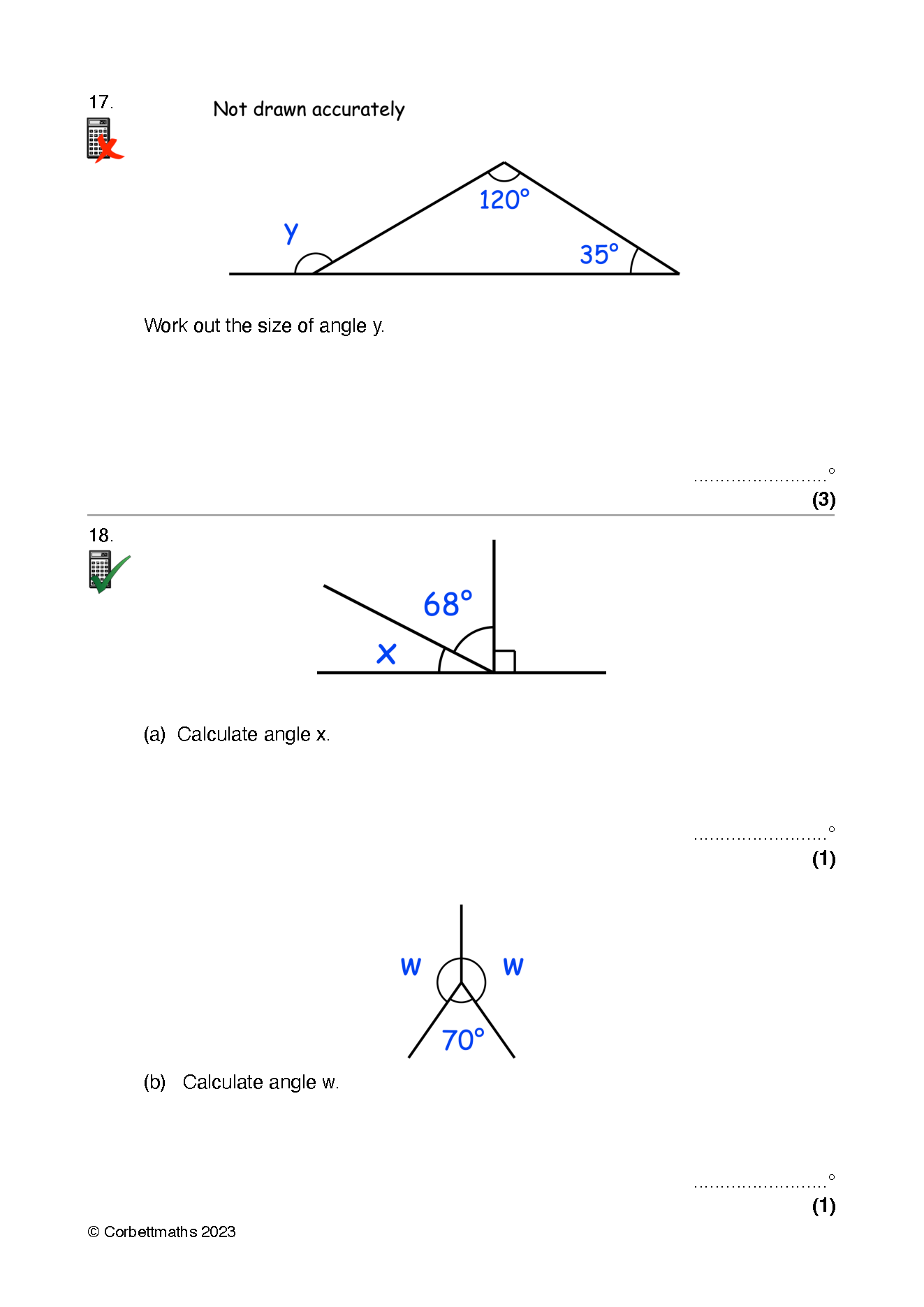
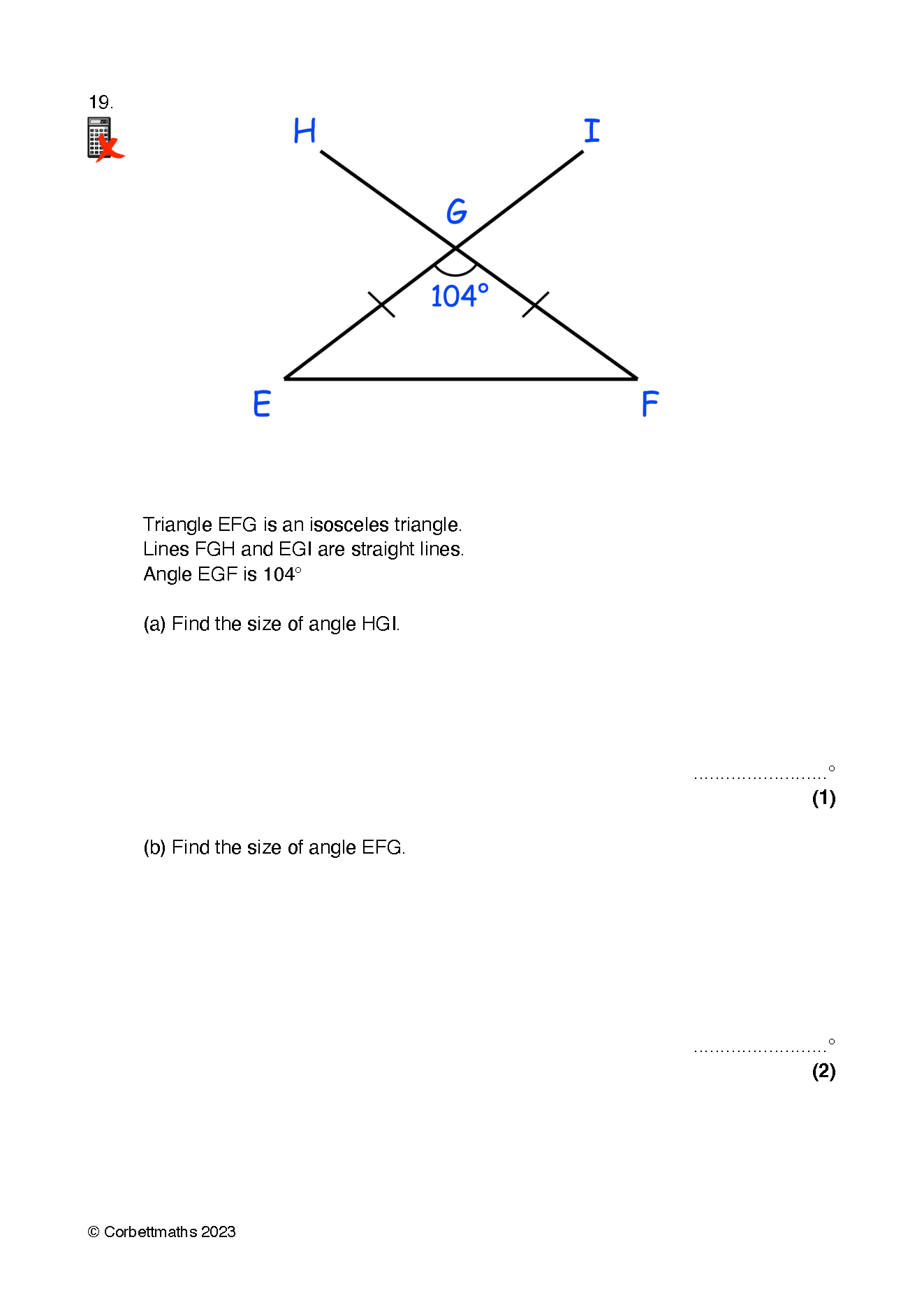
13. Mixed exam-style missing angles (stretch)
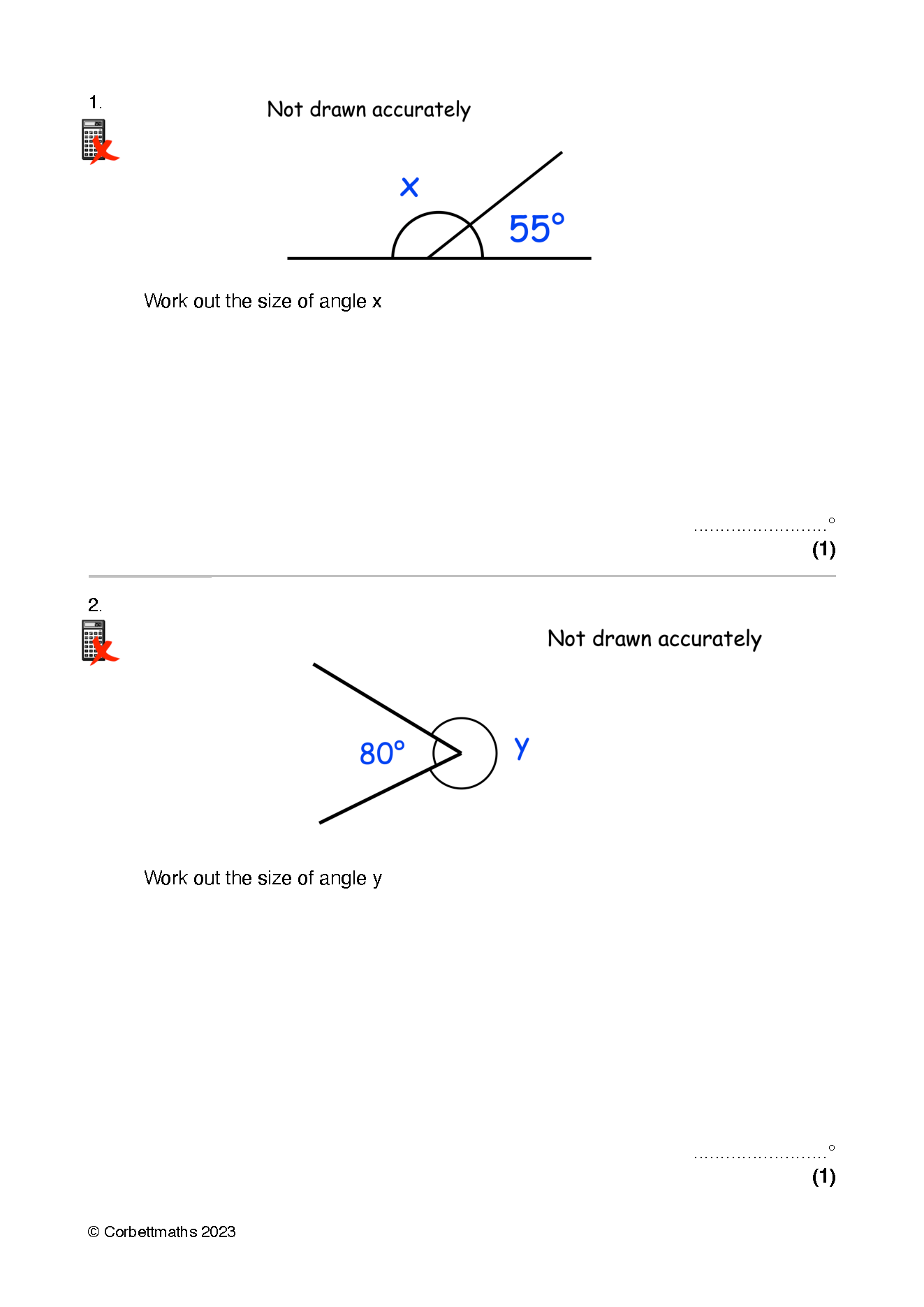
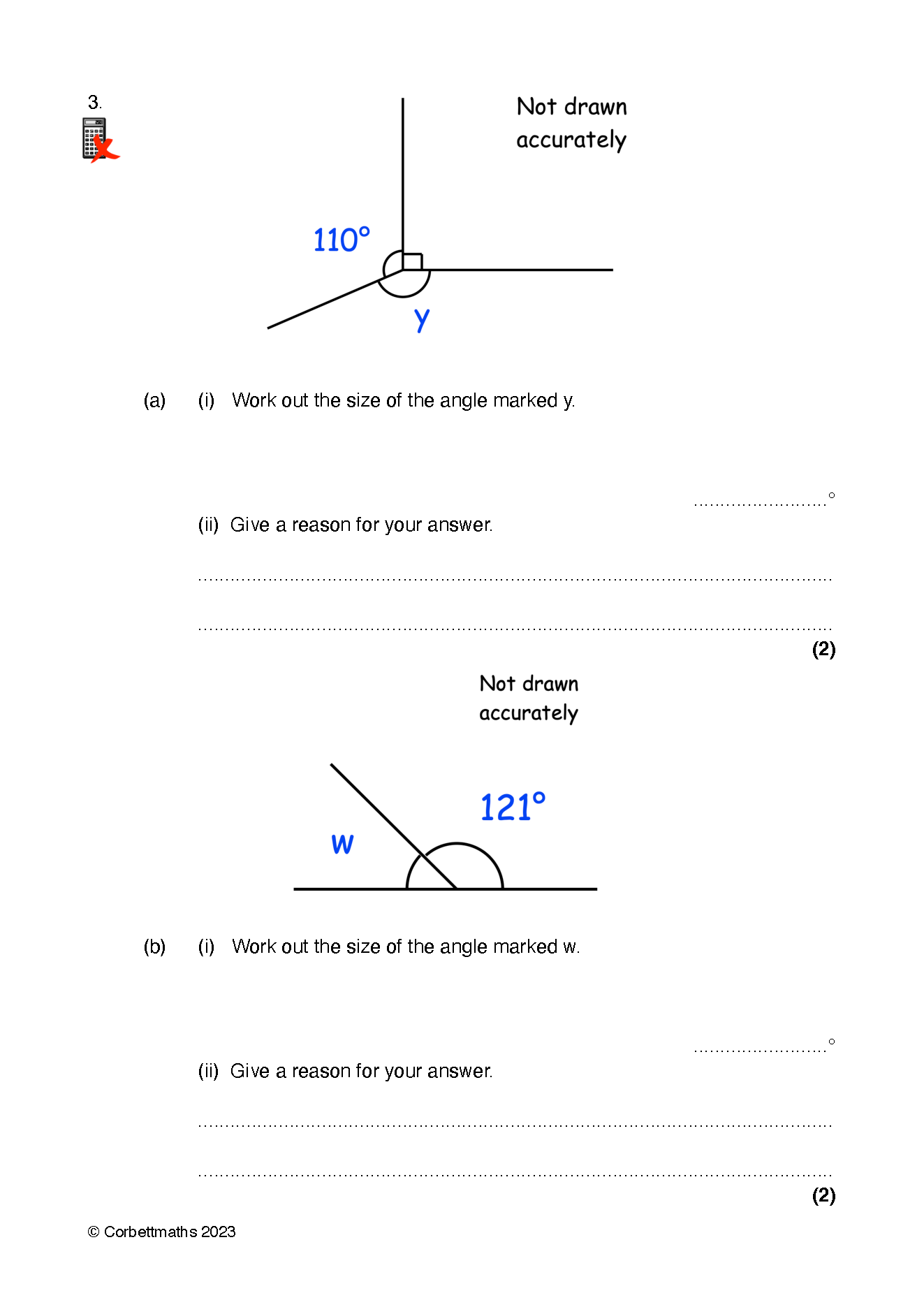
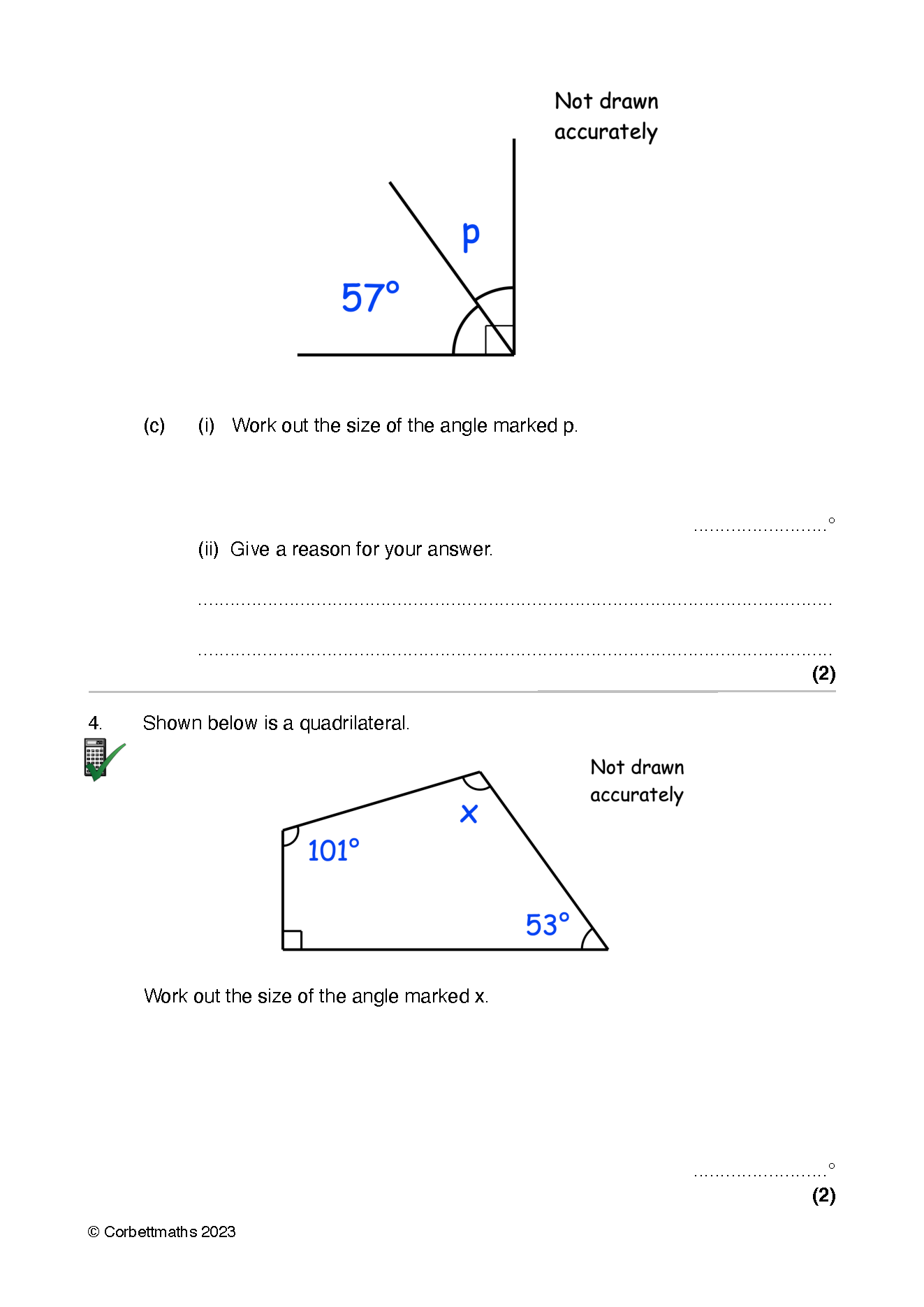
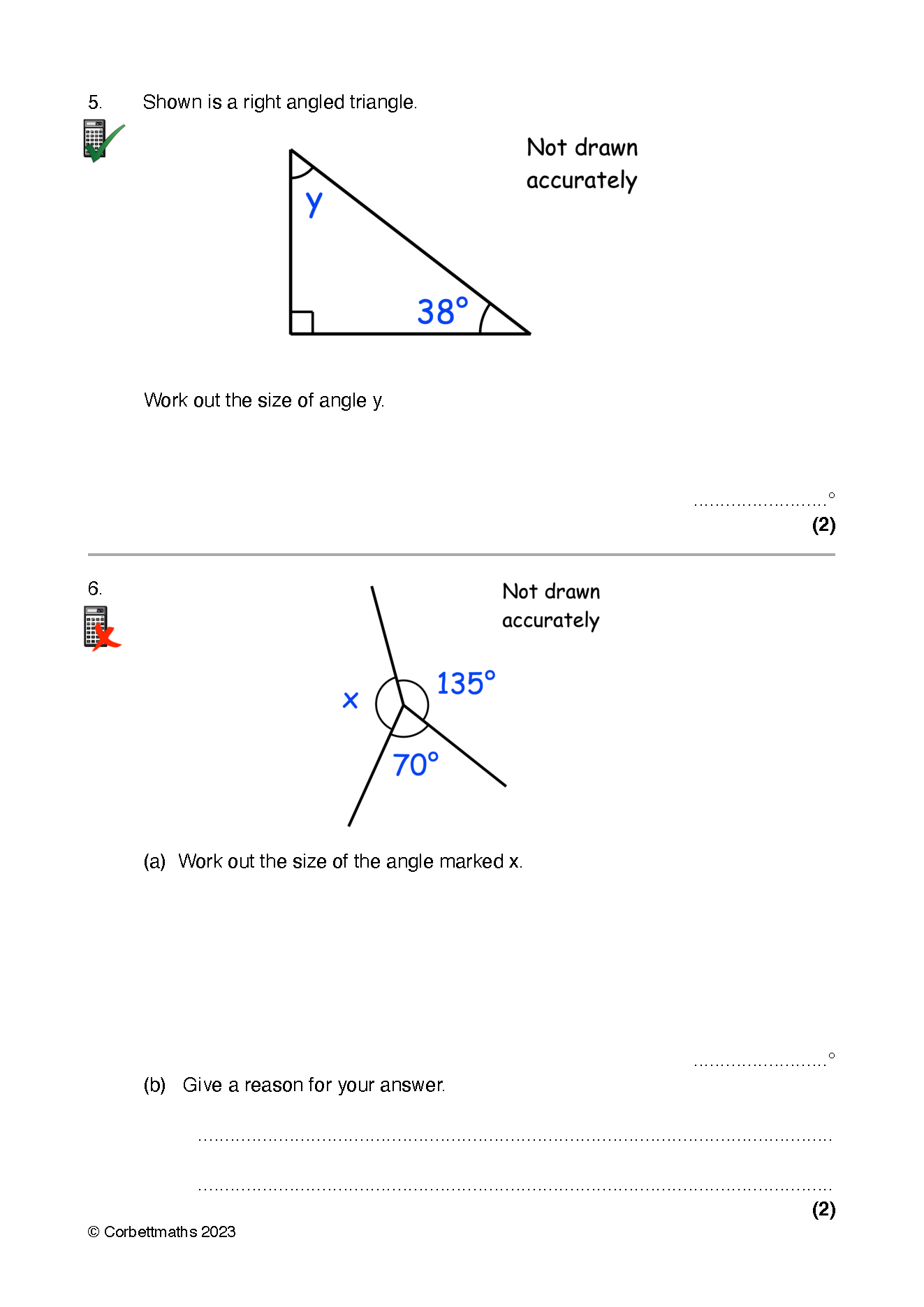
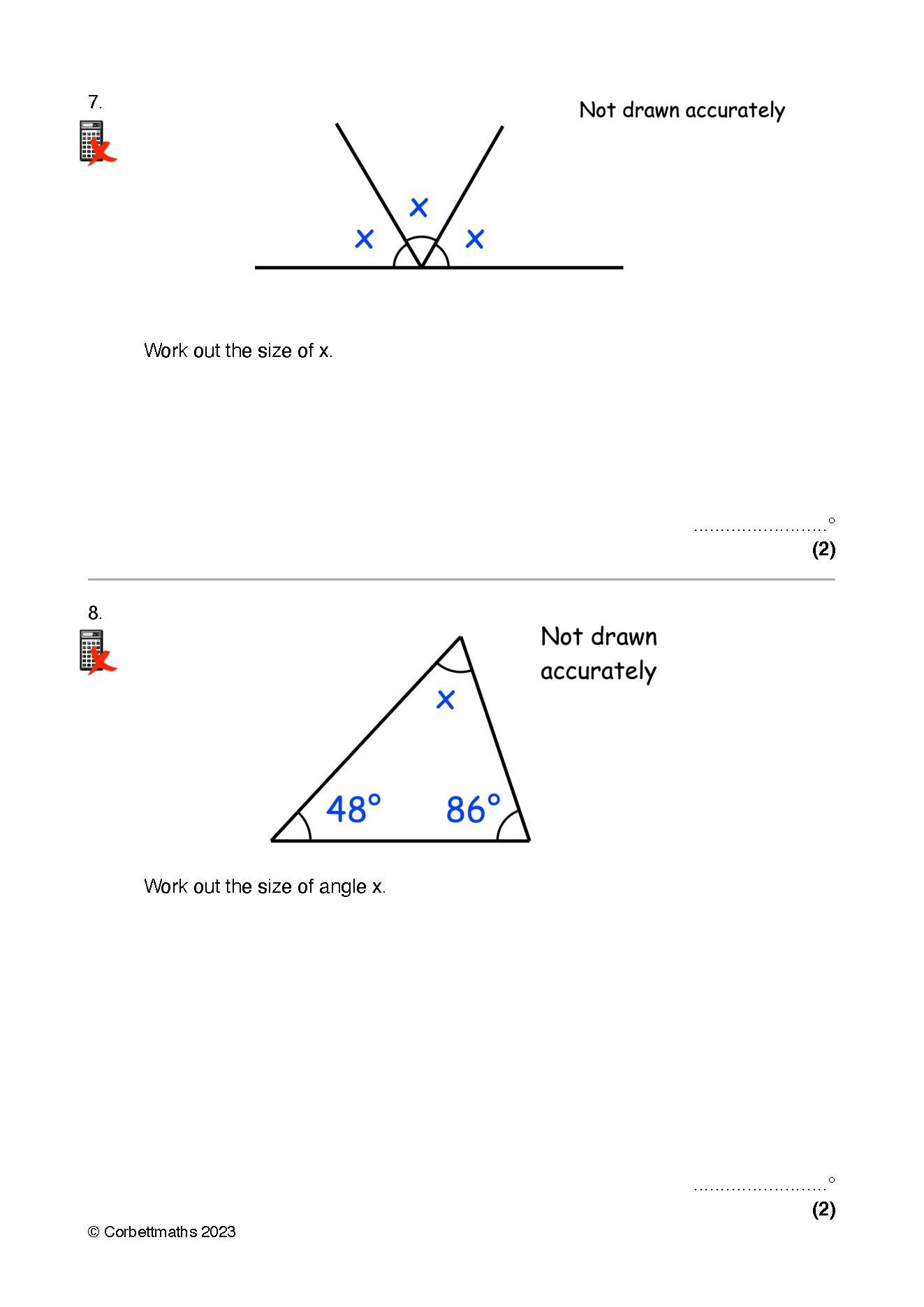
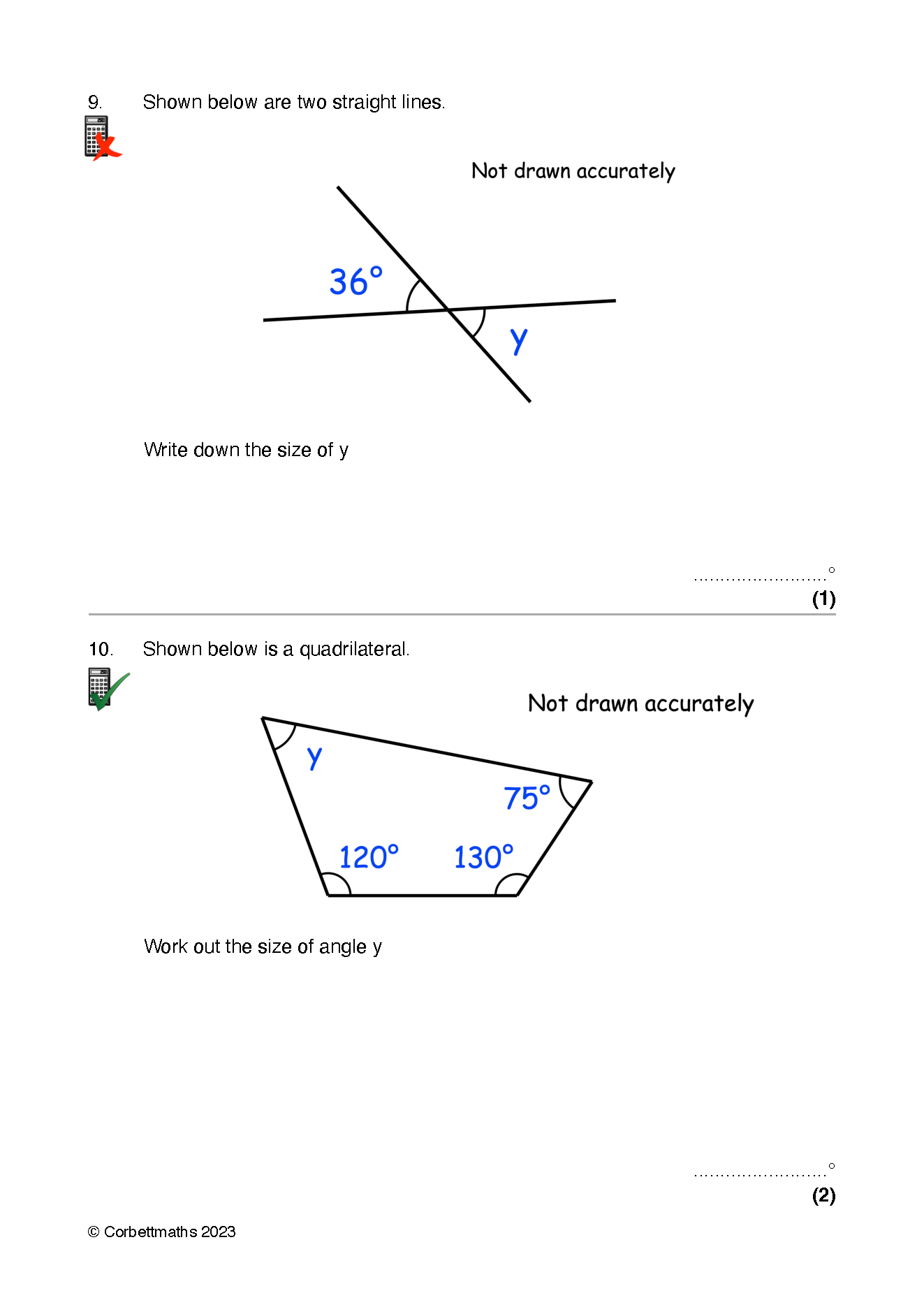
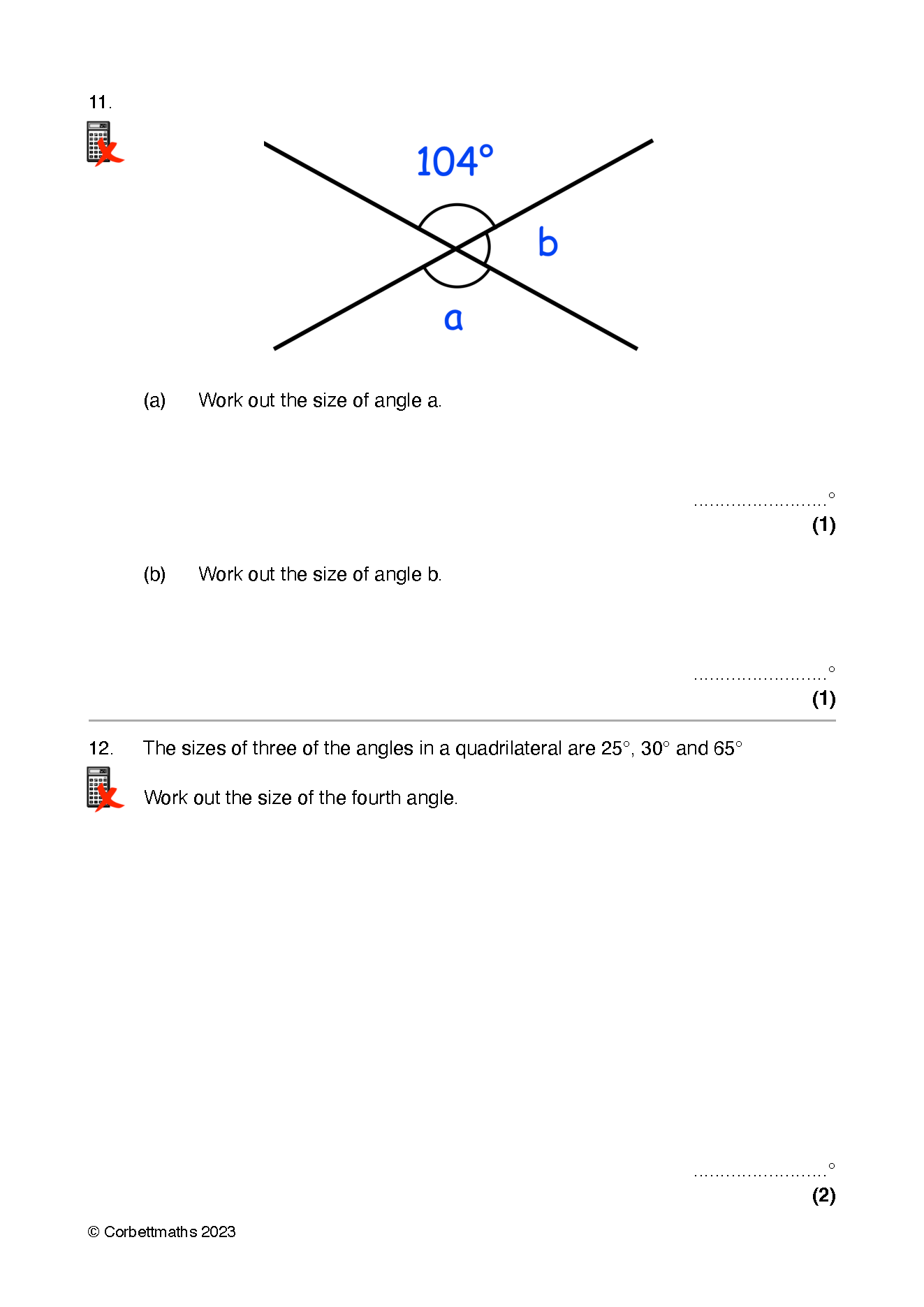
These questions mix the rules. Take your time: write the rule you are using each time (straight line / point / triangle / parallel…).
Lesson checklist
By the end you should be able to…
- use 90°, 180°, 360° rules in the correct situation
- find missing angles using triangles and quadrilaterals
- use isosceles and equilateral facts when you see equal sides
- use parallel line angle facts with a transversal
- show working in your book and mark honestly
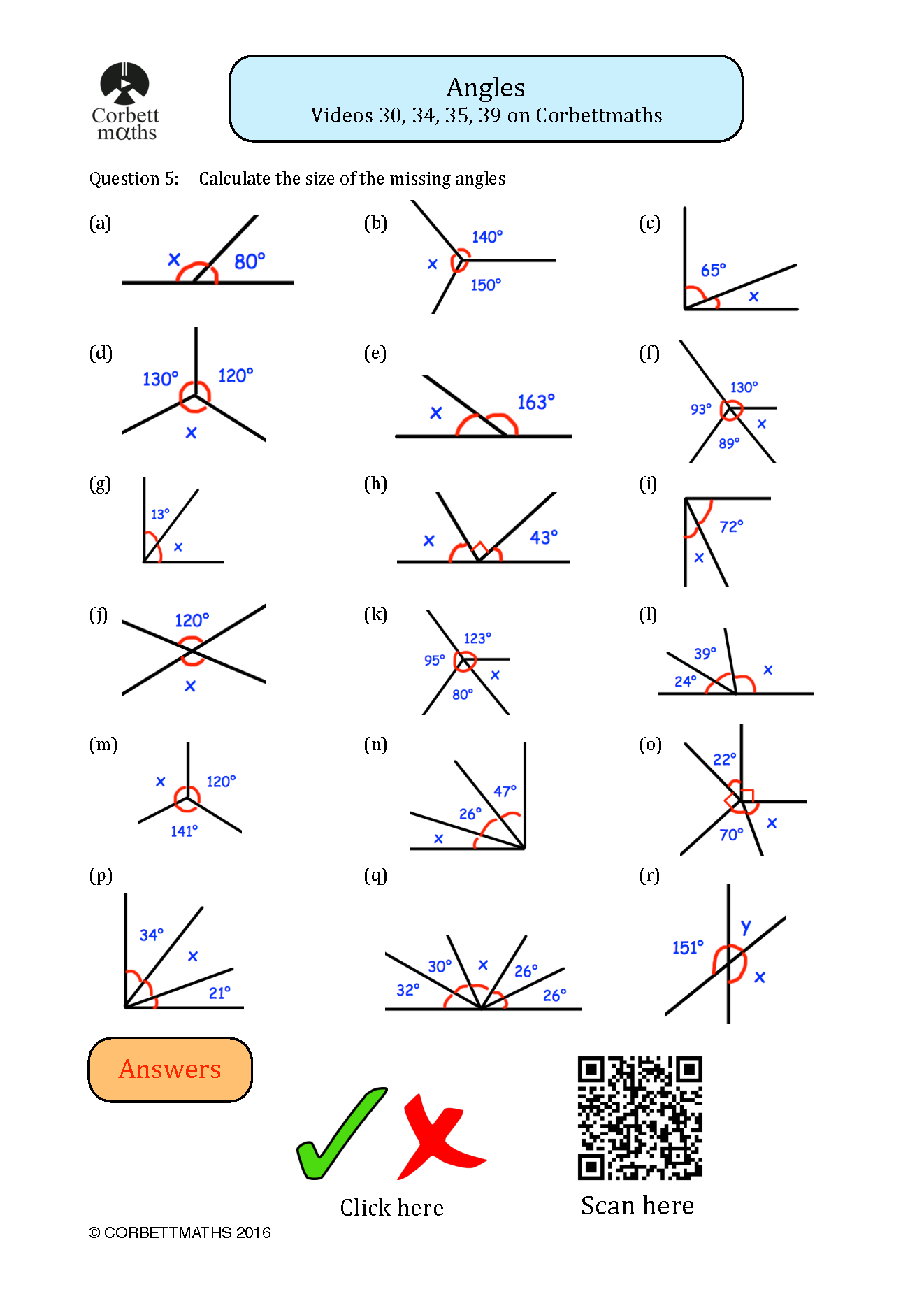
Extra mixed diagrams (Corbett “Angles” Question 5)
If you want more fluency, this page mixes several ideas in one diagram:
Mark — Question 5
Question 5 (mixed diagrams)
(a) 100° (b) 70° (c) 25° (d) 110° (e) 17° (f) 48° (g) 77° (h) 47° (i) 18° (j) 120° (k) 62° (l) 117° (m) 99° (n) 17°
(o) 178° (p) 35° (q) 66° (r) x = 29°, y = 151°